Cameraman Tower Defense Difficulty Progression
Plan Cameraman Tower Defense difficulty progression using a repeatable opening, current mode information, co-op coordination and focused review.
Learn on the easiest offered mode, repeat an understandable opening, then change one difficulty at a time. Read the current mode panel; reported wave counts and rewards can become outdated.
View reference image
On this page
Move up when your current clear is repeatable
Use the easiest mode offered by your current match to learn the map, your opening placement and the upgrade decisions that keep the lane covered. Move up one available difficulty after you can explain a successful run and repeat its important decisions. A single win carried by another player’s late unlocks tells you less about your own setup than a clear in which you understand what each defender did.
The official description of Aligators Games’ Cameraman Tower Defense says to beat waves to win. It does not publish a complete mode list or permanent payout table. An AllThingsHow report dated October 11, 2026 names Easy, Normal, Hard and Insane and shows a difficulty selection context. This guide uses those as dated reported options and tells you how to evaluate the live menu. It does not claim a personally tested Insane clear or current reward guarantee.
Read the difficulty panel before committing
Look for the available difficulty names, any wave information, rewards and restrictions shown in the current match. Compare those fields with your lineup and the time you have. A larger listed reward is only one part of the decision: you still need a route you can complete. Do not choose the hardest button simply because a guide or creator has a powerful roster on screen.
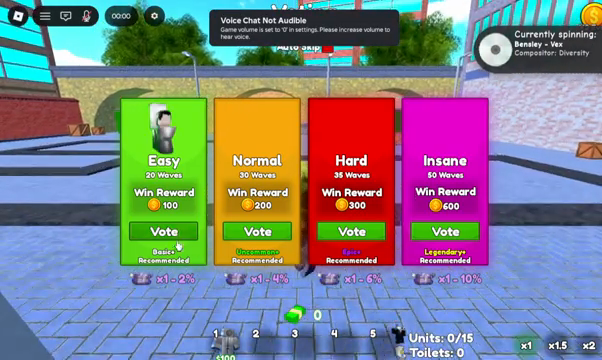
The October 10 VendoPlus video provides a visible example at 1:40. Its vote cards show the following snapshot. These are dated community gameplay observations, not values verified against the October 16 build. Read your current panel before planning a run.
| Mode in the October 10 video | Waves shown | Win coins shown | Recommendation printed on the card |
|---|---|---|---|
| Easy | 20 | 100 | Basic+ |
| Normal | 30 | 200 | Uncommon+ |
| Hard | 35 | 300 | Epic+ |
| Insane | 50 | 600 | Legendary+ |
The Hard card in the video says Epic+, while the October 11 written report says Rare+. That conflict is why this page preserves the dated frame instead of silently merging reports. Neither recommendation proves a guaranteed clear. If your live panel differs, use it for your attempt. The game’s update timestamp alone does not explain which modes or balances changed.
When playing with friends, agree on the intended difficulty before the vote. A group experimenting with new units has a different objective from a group seeking a reliable clear. Discuss whether the session is for learning or repeating something established. This coordination advice does not assume the voting system gives every player an identical role or override; follow the actual interface.
Establish a baseline on a map you can recognize
Use a familiar available map for your first comparison. The dated VendoPlus tutorial enters Toilet City and demonstrates early placements and upgrades. That is an example environment to recognize, not proof that every account must unlock maps in the same order. Check the platform destination in your current lobby and use the map you can actually enter.
During the baseline, identify the first affordable attacker, its position and the first planned upgrade. Watch the early route rather than immediately enabling every pace option. Note the first point where you need to change something. Even a failed baseline is useful if it reveals whether you lack early coverage, sufficient damage in a covered section, or a response to a later wave.
The beginner guide explains how to prepare a roster and enter the match. The upgrades and placement guide helps distinguish a gap in coverage from a shortage of damage. Use those observations before changing difficulty, so you know what problem the new run is asking you to solve.
Use a readiness checklist instead of a rarity requirement
Before moving up, answer four questions. Can you afford a first attacker when it is needed? Can you identify the path sections your setup covers? Do you know which upgrade or extra placement follows the opening? Can you describe why the previous attempt failed or succeeded? If those answers are unclear, another learning run can provide more value than an immediate difficulty increase.
A rarity recommendation in a community table is not proof that a lower rarity cannot win or that a higher rarity automatically does. Your equipped choices, deployment timing, coverage and the actual wave matter. This guide therefore does not prescribe an unverified minimum unit or copy a creator’s inventory as a requirement. Inspect your current units and assign each a job you can explain.
Also check practical conditions. Make sure you have enough time for the attempt and that your device is responsive enough to inspect panels and place deliberately. A loss caused by leaving the match or missing inputs does not establish a balance problem. Keep those observations separate from a strategic failure when reviewing the result.
Change one source of difficulty at a time
Try the next available mode on the same map with a familiar opening before also replacing the whole team. That gives you a clearer comparison. If you change mode, map, lineup and pace together, a different result will be difficult to explain. A controlled progression step helps you identify which part of the old plan needs improvement.
Watch for the earliest difference from the baseline. Maybe a previously safe section begins leaking, or you need an upgrade earlier than before. Record that first meaningful change rather than focusing only on the final defeat. The point at which the plan stops working is the most useful place to redesign it.
Do not assume enemy health scales by a fixed multiplier between modes. The official page does not publish that relationship, and a reported wave count cannot prove it. Read the current enemy and unit information where available. If the game introduces an unfamiliar mechanic, describe what you see instead of assigning it a borrowed rule from another tower defense title.
Compare reliable clears with ambitious attempts
For progression, think about outcomes you can reproduce. Repeatedly failing a harder mode can be worthwhile when each attempt tests a clear improvement. It is less informative when the same opening fails for the same unexamined reason. Return to an easier available mode to test a placement or learn a new unit if that gives you better feedback.
Do not turn a displayed win reward into an earning-rate promise. A meaningful comparison would need actual completion times, failure rates and current payout evidence. This site has not measured those inputs. You can make a personal note of time spent and the result, but label it as your own session rather than assuming it applies to every player or team.
Keep promotional rewards separate from repeatable matches. A group offer or code, if currently available, may be a one-time event with eligibility conditions. It does not prove a steady income route. The October tutorial and report describe such offers, but this guide does not label them personally redeemed or guarantee their availability today.
Coordinate co-op around the failure you are solving
Agree who handles the opening and which player watches the late route. Share observations when an enemy leaves coverage, and discuss whether an upgrade or new position addresses that point. If every player independently saves for an expensive unit, the opening may be neglected; if everyone copies the same spot, the group may miss another useful section.
Each player should inspect their own balance and available placement rules. The public official description does not define a shared economy, maximum contribution or every co-op interaction. Avoid assuming your friend’s resources are yours or that a lobby server-size number is the match capacity. The current pad and match interface provide the relevant conditions.
Review, update and return with one objective
After an attempt, record the date, current map and mode, first troublesome wave or enemy, and the change you intend to make. If you won, note which decisions were essential rather than assuming every placement was necessary. If another player carried a section, record that too. It keeps the result useful when you later try solo or with a different team.
Recheck the official page and live menus after an update. A new title banner or update timestamp establishes activity, not a detailed changelog. Move forward when your observations support it: one understandable opening, one deliberate progression step and one change to test next. That gives your difficulty progression a practical direction without inventing a guaranteed team, a universal farming mode or a permanent reward table.
Step-by-step guide
- Establish a baseline
Choose the easiest current option and learn a repeatable opening on an available map.
- Inspect the next mode
Read the present difficulty panel and discuss the intended mode before a co-op vote.
- Change one variable
Try a new difficulty with a familiar setup, record the earliest new problem and use that evidence for the next attempt.
Video evidence
Watch creator walkthroughs alongside this guide. Check the recording date before following requirements that may have changed.
How to Play Cameraman Tower Defense: Full Guide
A short lobby-to-match example: unit menus, Toilet City entry, placing units and inspecting upgrades. Its run is an example, not proof of every mode.
Sources
Recheck these links whenever the game version, release status, or strategy changes.
- Aligators Games official Roblox description Checked October 16, 2026. Primary source for identity and explicitly advertised mechanics.
- Roblox public game API Official identity and update snapshot. Counts are volatile and are not used as progression rules.
- AllThingsHow gameplay explainer, October 11 Dated secondary reporting with VendoPlus frame provenance. Live menus take priority; no current rates or mode payout table promised.
- MBT gameplay, 2026-10-12 Overview explicitly naming Aligators Games and repeating the official match-platform and wave-defense description.
- VendoPlus gameplay, 2026-10-10 A short lobby-to-match example: unit menus, Toilet City entry, placing units and inspecting upgrades. Its run is an example, not proof of every mode.